
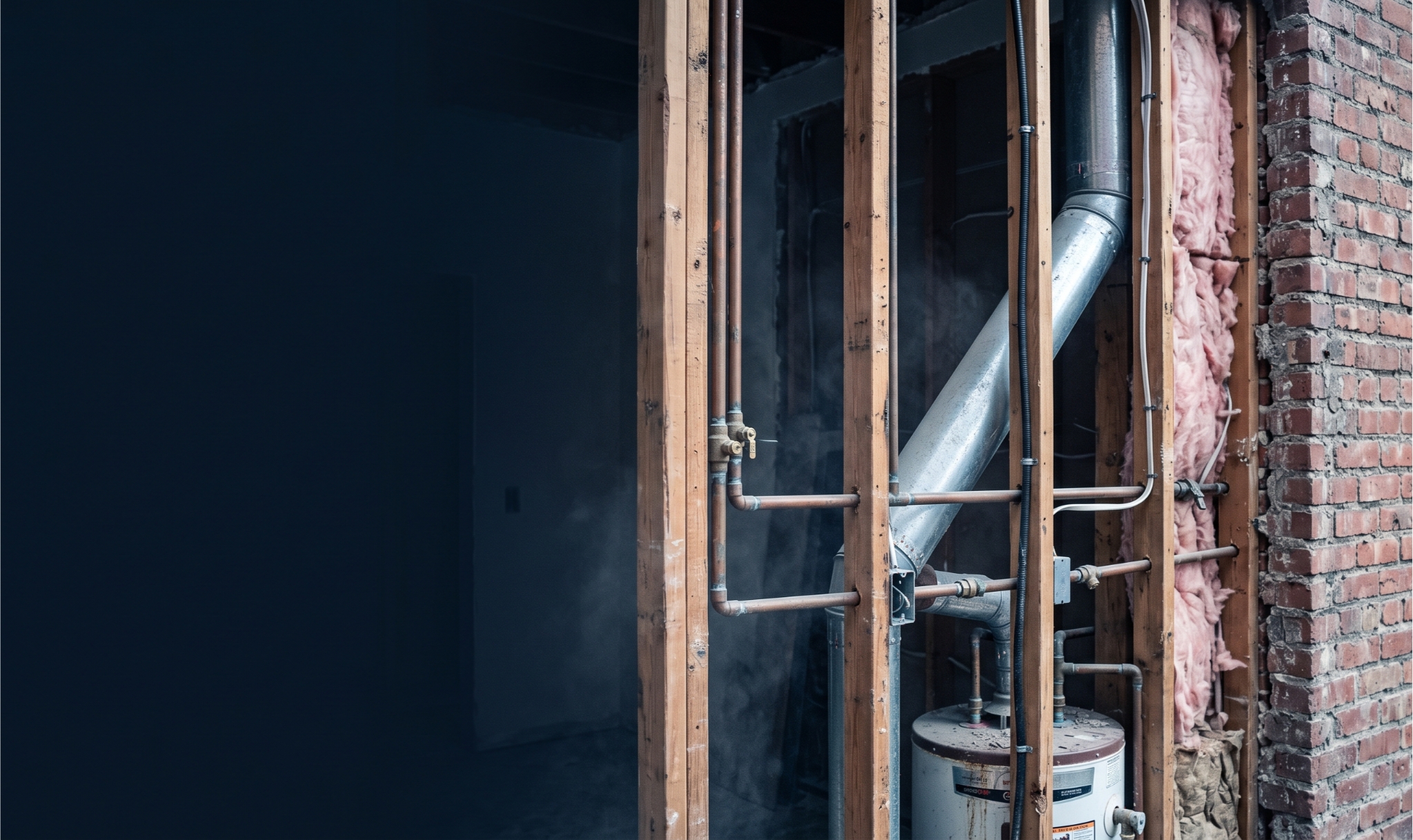
The Money Behind the Walls.
An energy audit guide for property owners — built to find the 10–30% of operating cost your building has been quietly losing before the next rate hike makes it bigger.
30-day money-back guarantee · Instant download · Jon’s audit forms included





Your building is bleeding money. Most owners don’t know how much, or where.
Utility cost is the only line on your P&L that doesn’t stop climbing. Most operators write the check every month and treat the number as fixed. It’s not. An energy audit guide for property owners shows you what you’ve been paying for, what’s normal for your building, and what’s actually recoverable — before the next rate hike makes the bill bigger.
The average commercial building wastes 30% of the energy it consumes. On a typical 100-unit property running ~$1,300 per unit in annual utilities, that’s roughly $39,000 a year going straight out the building. Most owners write the check without ever asking why it’s that big.
EPA · ENERGY STAR · NAA 2024 benchmarkA standard ASHRAE Level II audit identifies 10–30% of energy cost as recoverable savings. Audits run $0.15–$0.25 per square foot. On a 100,000 sq ft building, a $20K audit finds $50K–$150K in annual recoverable cost. The audit pays for itself in months. The savings keep paying for years.
ASHRAE · Abraxas Energy ConsultingIn 2025, US utilities requested over $31 billion in rate hikes — more than 2x what they asked for the year before. Electricity rose 7%, natural gas 11%, water and sewer 5.1%. All outpacing inflation by 2x to 3x. This is the only line on your P&L that goes up every year, no matter what you do.
American Progress · EIAEnergy conservation is the only investment that increases in value over time.
— Jon Weiskopf, PE
Why This Comes From Me.
Most real estate education teaches you to model returns. I audit the building those returns depend on.
Licensed Professional Engineer in 4 states. 20 years engineering 400+ buildings across 20+ countries. 9 of those years at Apple — running engineering for one of the largest retail portfolios in the world. 300+ stores globally.
I built my energy audit practice at Steven Winter Associates, ran a nationwide audit for the US Postal Service as a junior engineer, and have been running this framework on every building I underwrite ever since. The building is the input to the spreadsheet. This guide is the lens.
When I audit a building, I baseline it. I benchmark it. I score every system on payback against the hold period. That’s the framework. That’s what this guide gives you.
The Energy Audit Framework I Use Before I Sign a Retrofit Check.
A 4-phase energy audit guide for property owners — built to find the operating cost your building has been losing and sequence what to fix by payback against your hold period. You walk away with a baseline, a benchmark, a target, and a prioritized list — in your hands, on paper, today.
A measurement, not a guess.
Reads the bills. Walks the building. Tells you where the money is leaving and what it’ll cost to stop it.
Built for the owner, not the auditor.
You don’t need ASHRAE training. You need to know what to ask for, what to record, and what every line item should tell you.
Field-ready in a day.
Print Jon’s forms. Walk the building system by system. Score on the page. Walk out with the baseline that drives every retrofit decision after.
The Energy Audit Process, Step by Step.
The 4-phase energy audit framework I’ve run on buildings from 70-unit walk-ups to federal-scale portfolios. Each phase feeds the next. Skip one and the math breaks.
Establish what the building actually consumes. 12 months of utility bills. Equipment inventory with ages. Operating profile. Site characteristics. The foundation everything else stands on.
You can’t fix what you haven’t measured.
Compare your actual usage to expected — for your building’s type, age, climate, and use pattern. Energy Use Intensity. Regional comparisons. Climate-adjusted normalization. Translates a number into a story.
The benchmark tells you whether the bill is normal — or a story.
Set the goal. 15%? 30%? Net zero? Calibrated to your investment thesis, hold period, and capital appetite. The audit’s job is to make the target real, not aspirational.
Make the target real, not aspirational.
Sort retrofits by payback against your hold period. Under 3 years is a no-brainer. Under 5 is target. Under 10 puts you ahead. Phase the rest. Defer the rest after that.
Walk away with a list, a sequence, and the math behind every line.
See What’s Inside — Before You Buy.
The full guide gives you all 4 phases at this depth — Jon’s audit forms for every phase, scoring on the page, field notes, red flag lists, and protection tips for evaluating the consultants you hire. Below: Phase 1 in full, plus a partial of Phase 2.
Baseline.
You can’t fix what you haven’t measured.What’s at Stake
Baselining is the foundation of every audit. Skip it and every retrofit decision after is a guess. Get it right and the next three phases write themselves. The most expensive audits are the ones that look thorough but skip the baseline — they sell you on retrofits without ever proving the savings are there.
What to Gather (5 of 9 items; full list in the guide)
- 12 months of utility bills — electric, gas, water/sewer, fuel oil if applicable. Mapped by month. Anomalies flagged.
- Equipment inventory with ages — HVAC units, water heaters, boilers, lighting, pumps, controls. Type, capacity, age, location.
- Operating profile — occupancy schedule, common-area hours, seasonal patterns, vacancy rate impact on usage.
- Site characteristics — square footage by use type, building envelope details, system zoning, climate zone.
- Existing audit and retrofit history — what’s been done, what hasn’t, what was recommended but never executed.
Scoring Examples
- Score 1 — Less than 6 months of bills. No equipment inventory. No operating profile. The audit is a guess from here.
- Score 3 — 12 months of bills mapped. Partial equipment inventory. Operating profile estimated, not documented.
- Score 5 — 24 months of bills, equipment inventory by location with ages, documented operating profile, retrofit history pulled.
Red Flags
- An auditor who quotes you a retrofit list without first showing you a documented baseline. They’re guessing — and you’re paying for the guess.
- Bills with missing months or estimated reads. The seller may have lost them. The utility may have estimated them. Either way, your baseline is wrong.
- No equipment ages on the inventory. Ages drive the lifecycle math. Without them, the prioritization phase falls apart.
What It Costs When You Miss It
A Phase 1 done wrong gives you the wrong target, the wrong priorities, and retrofits that don’t pay back. The audit fee was the cheap part — the wasted retrofit capital is the expensive part. On a value-add deal, a bad baseline can sink your CapEx budget by 30–50% before you’ve even broken ground.
Jon’s Field Note
Protection Tip — How to evaluate your auditor
Ask to see the baseline data they’re working from before you accept any retrofit recommendation. If they can’t produce 12 months of bills mapped to your equipment inventory and operating profile, they’re working from intuition, not measurement. A real audit shows its work. If your auditor’s report skips straight to “recommended retrofits,” that’s not a finding — that’s a sales pitch.
Benchmark.
Turns numbers into meaning.What’s at Stake
Benchmarking is what separates “this bill seems high” from “this bill is 38% above peer median for your building type and climate zone.” Without it, you don’t know whether 30 kWh per square foot per year is reasonable or wasteful. With it, the audit gets specific about where the gap is — and how much of it is recoverable.
What to Run (first 3 of 8 shown)
- Energy Use Intensity (EUI). Total energy use per square foot per year. The single most diagnostic number in any audit.
- ENERGY STAR Portfolio Manager comparison. Run your building against the regional and national peer set. A score under 50 is a red flag worth chasing.
- Climate-adjusted normalization. Heating and cooling degree days. Without normalization, last year’s mild winter looks like a savings win when it was just weather.
Jon’s Field Note
A Real Method. Not a Retrofit List.
Every retrofit gets evaluated against one number: payback against your hold period. Most consultants give you a list. The audit gives you a sequence.
A 6-month payback LED retrofit on a 5-year hold is a no-brainer. A 9-year payback envelope retrofit on a 3-year hold is somebody else’s problem. The math tells you which is which — before you sign the check.
| Payback Window | Decision | Recommended Action |
|---|---|---|
| Under 3 years | No-brainer | Do it. The savings recover the cost while you still own the building. |
| 3–5 years | Target zone | Schedule into your CapEx plan. Aligns with most hold periods. |
| 5–10 years | Puts you ahead | Phase into hold-period planning. Often pairs with rebates that change the math. |
| Over 10 years | Defer | Wait for rebates, compliance changes, or capital events to change the payback. |
The math goes on the page. The decision becomes obvious.
How You Use It.
You gather.
Pull 12 months of utility bills. Run the equipment inventory. Document the operating profile. The guide tells you what to collect and how to organize it.
You walk.
Print Jon’s audit forms. Walk the building system by system. Score on the page as you go. The forms tell you what to look at and what to record.
You decide.
Transfer scores to the payback grid. The math gives you the sequence: which retrofits to fund now, which to phase, which to defer.
The Founding Rate.
This is the lowest the price will ever be. After the first 100 buyers, it goes to $79 — and stays there.
First 100 buyers · founding rate
30-day money-back guarantee. If you work through it and it doesn’t deliver, email us. Refund issued. No questions.
Where This Energy Audit Method Has Worked.
The framework in this energy audit guide for property owners didn’t come from a textbook. It came from running audits — on consulting engagements, on properties I underwrite, and on a federal portfolio early in my career.
NYC Building — ~40% Reduction.
A consulting engagement on a New York building. The audit identified retrofits the owner had been told weren’t worth doing. Monthly energy bill dropped nearly 40%. The savings had been sitting on the table the whole time. Nobody had measured.
Payback under 2 years. Audit-driven retrofit sequence.
Tennessee 70-Unit — Walk-Away.
A 70-unit deal where the audit lens caught what the spreadsheet didn’t. Every HVAC unit was 18+ years old. Replacement cost broke the CapEx math at the asking price. Seller wouldn’t move. I walked. The audit framework killed a bad deal before the check went out.
Saved the investment. Audit framework as risk filter.
US Postal Service — Nationwide Audit.
As a junior engineer, I led a nationwide energy audit and modeling effort for the US Postal Service. Federal scale. That’s where I learned what an audit actually does, what it costs you to skip one, and which findings hide in operating profiles versus equipment lists. The forms in this guide trace back to what worked on that project.
The framework’s origin. Federal-scale validation.
2 Ways This Goes.
You operate without measuring.
- Pay the utility bill every month and treat the number as fixed.
- Hire an auditor with no idea what their report should contain.
- Defer retrofits because the payback was never explained against your hold period.
- Watch utility rate hikes eat your NOI, year after year.
You measure first. Then you act.
- Know exactly what the building consumes — and what’s normal for it.
- Hire auditors against a spec. Grade their findings against your baseline.
- Sequence retrofits by payback against your hold period. No guessing.
- Recover 10–30% of utility cost — and harden your NOI against rate hikes that aren’t slowing down.
Audit the Building Before the Building Audits You.
Utility cost is the one expense that never stops climbing. Every month you operate without measuring is a month you’re writing a check you didn’t have to write.
This energy audit guide for property owners gives you the method. Baseline, benchmark, target, prioritize. Find what’s recoverable. Sequence it by payback. Harden your NOI against rate hikes that aren’t slowing down.
Energy conservation is the only investment that increases in value over time.
Get The Money Behind the Walls — $4930-day money-back guarantee · Instant download · Jon’s audit forms included
First 100 buyers · founding rate