The $100K Blind Spot.
A real estate due diligence checklist for buyers. 9 systems that decide whether your next deal makes you money — or costs you a six-figure surprise.
30-day money-back guarantee · Instant download · 2 purchase bonuses included





You’re about to write a six-figure check on a building you can’t independently evaluate.
An inspection report isn’t a real estate due diligence checklist. It tells you what was visible, what was accessible, what fit inside the inspector’s scope. It doesn’t tell you what’s behind the walls, what the seller would rather you not notice, or what 30 years of deferred maintenance is quietly doing to every system you’re about to inherit.
200-unit deal. Seller wanted every unit walked in one day. The on-site escorts kept steering my team away from certain spaces. We tracked the unit numbers as we went. Doubled back. Found mold-blackened bathroom ceilings in the units they didn’t want us seeing.
Watched a plumbing contractor tap a live gas line during a renovation. One spark and the room is gone. The contractor didn’t know it was hot. The owner didn’t have anyone on-site who would have known either.
16 acres. Offer raised from $7M to $10M. Seller accepted. Then demanded a 30-day due diligence. The land broker mentioned expansive soils. Walked away. Seller defaulted three months later.
If you don’t know what the hell you have, you will have the hell you own.
— Jon Weiskopf, PE
Why This Comes From Me.
Most real estate education teaches the spreadsheet. I read the building.
Licensed Professional Engineer in 4 states. 20 years engineering 400+ buildings across 20+ countries. 9 of those years at Apple — running engineering for one of the largest retail portfolios in the world. 300+ stores globally.
I founded Blue Eyed Capital because the knowledge of buildings is gravely missing from real estate. The building is the input to the spreadsheet. This guide is the lens I use on my own deals and on every loan I underwrite.
When I evaluate a property, I walk it. I read it. I ask questions that matter. That’s what this guide gives you.
The Real Estate Due Diligence Checklist I Use Before I Commit Capital.
A 9-system scored real estate due diligence checklist for evaluating a building before you buy it. Each system is ranked by consequence. The page does the math. You walk away with a Building Score out of 100 and a clear recommendation: proceed, reprice, investigate, or walk.
A real methodology, not a checklist.
Weighted scoring across 9 systems rolls to a single 0–100 Building Score.
Built for the buyer, not the engineer.
You don’t need a degree. You need to know what to look at, what to ask, and what not to believe.
Field-ready in under 2 hours.
Print it. Walk the property. Score on the page. Decide before you offer.
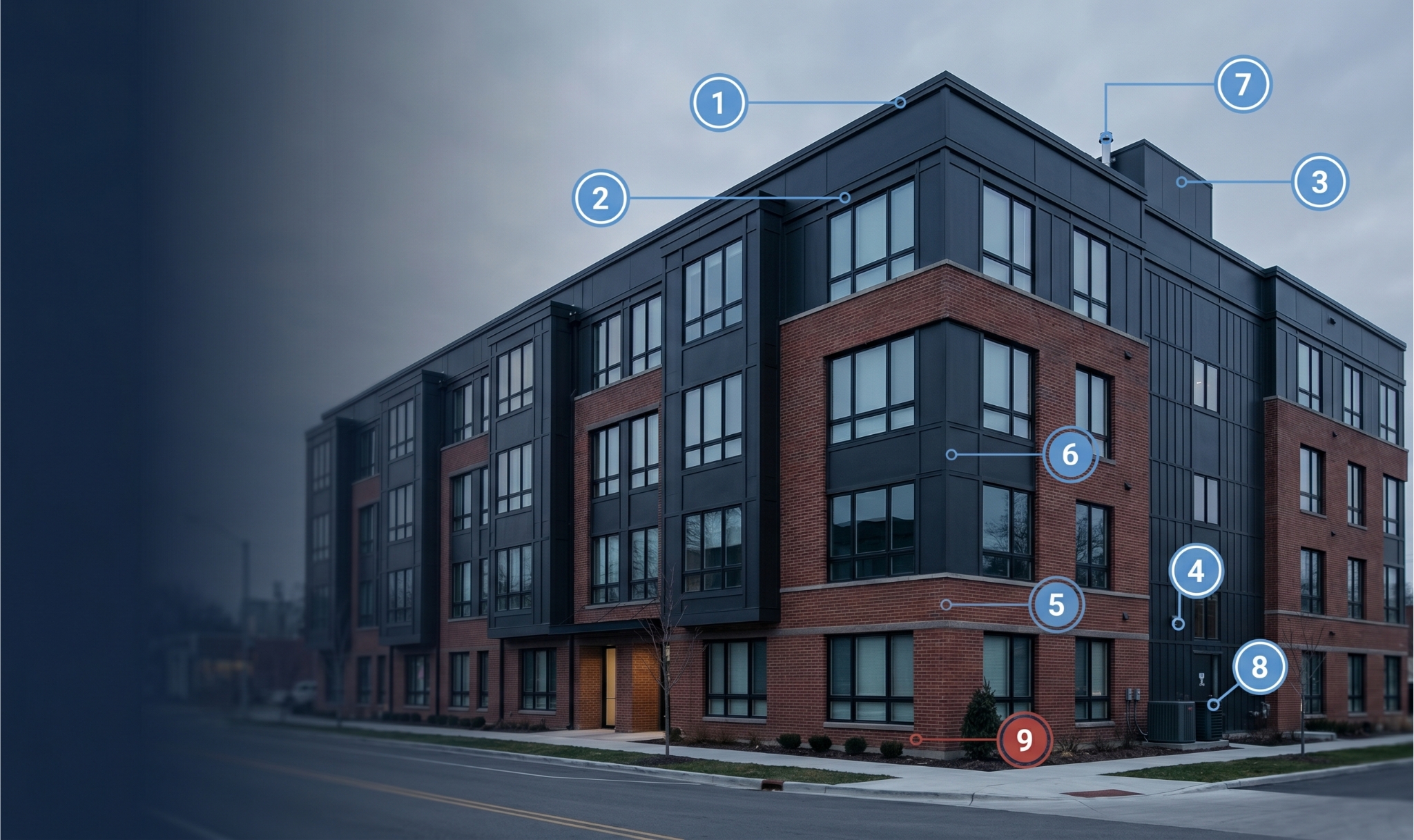
The 9 Systems, Ranked by Consequence.
Every system carries a weight. Structural failures bankrupt deals. Pest problems cost money. Both matter — but not equally.
The umbrella that reveals everything else. Skip it and you inherit a building running 30–50% above what it should cost to operate.
Catastrophic. Non-negotiable. You can’t patch it, phase it, or defer it. If the structure is compromised, nothing else on the list matters.
What keeps the outside out. When the envelope fails, water gets in — and the damage happens behind the walls long before you see it.
The system that hides underground. Cracked sewer lines and aging water heaters are invisible until they’re emergencies. Emergencies don’t wait for business hours.
The highest complaint generator in any building. A fleet of aging units with no replacement plan is death by a thousand cuts.
Where erosion meets foundation. Drainage problems become structural problems faster than you’d expect.
Structural damage if undetected. Termites and rodents work where you can’t see them.
Where mold lives and people don’t go. The space most likely to be ignored, hiding the problems most likely to spread.
Code-required and operationally critical. An open fire code violation can shut you down on day one.
See What’s Inside — Before You Buy.
The full guide gives you all 9 systems at this depth — scoring examples for every system, complete red flag lists, cost ranges, Jon’s field notes, and protection tips on every page. Below: Priority 1 in full, plus a partial of Priority 3.
Structural.
Catastrophic. Non-negotiable.What’s at Stake
You can’t patch structural problems. You can’t phase them. You can’t defer them. If the structure is compromised, everything else becomes irrelevant — you can’t operate a building that isn’t structurally sound. Being wrong here can cost you the entire investment.
What to Look For (5 of 7 items; full list in the guide)
- Foundation — visible cracks, settling, water intrusion at the base, evidence of shifting.
- Load-bearing walls — diagonal cracks = settling; horizontal = lateral pressure. Bowing or deflection in any wall.
- Roof structure (not the membrane — the bones). Sagging, uneven ridge lines, water ponding evidence.
- Exterior masonry — spalling brick, deteriorating mortar joints, efflorescence (white salt deposits = water migrating through the wall).
- Evidence of prior structural repair — steel plates, sister joists, epoxy injection. Tells you the building has had problems.
Scoring Examples
- Score 1 — Pattern cracking in foundation, visible settling, doors and windows not operating building-wide.
- Score 3 — Isolated cracks, minor settling evidence, no water penetration at foundation.
- Score 5 — No cracking, level floors, no settlement, recently assessed or reinforced.
Red Flags
- Pattern cracking in foundation walls (diagonal or stair-step). Isolated hairlines are normal. Patterns mean something is moving.
- Doors and windows building-wide that no longer open or close properly. Indicates structural movement.
- Previous structural repairs that look rushed or incomplete. If someone tried to fix it and the problem is still visible, the fix didn’t hold.
What It Costs When You Miss It
Structural failure can make a building uninhabitable — total income loss, resident displacement, legal liability, potential condemnation. Repair ranges from $10K (minor foundation work) to $200K+ (major stabilization). Catching it in due diligence is the difference between a deal point and a disaster.
Jon’s Field Note
Protection Tip — How to evaluate your inspector
Most investors don’t understand structural — it’s a universal blind spot. If anything during your walk raises concern, bring in a licensed structural engineer. Not a GC. Not a home inspector. The cost of that specialist is trivial compared to the cost of being wrong on structure. If your inspector’s report says “recommend further evaluation by a structural engineer” — that’s not a suggestion. That’s a red flag disguised as a recommendation.
Plumbing & Water Heating.
The system that hides underground.What’s at Stake
Plumbing goes where you can’t see — underground, behind walls, through floors. Used every day by every resident. Problems are invisible until they’re emergencies. Emergencies don’t wait for business hours. The worst plumbing failures cascade — a sewer backup doesn’t just break a pipe, it evacuates a building.
What to Look For (first 3 of 9 shown)
- Main sewer line scope. Pay for a video scope of the main line leaving the building. The single highest-value inspection item most investors skip. Budget $300–$500.
- Sanitary line material. Cast iron (begins to break at 50 years), polybutylene. Both failure-prone on a known timeline.
- Water heater inventory. Count, type, age, AND location. The location is the risk multiplier.
Jon’s Field Note
More Than a Real Estate Due Diligence Checklist. A Weighted Methodology.
Each system gets a raw 1–5 score. The field card applies a weight multiplier. Higher-priority systems carry more weight because their failures carry higher consequences.
A structural score of 2 (×4 = 8/20) hurts your Building Score more than a pest score of 2 (×1 = 2/5) — and it should. That’s how the risk actually works.
| Building Score | Assessment | Recommended Action |
|---|---|---|
| 85–100 | Strong candidate | Proceed with standard due diligence and closing |
| 65–84 | Proceed with conditions | Price the deficiencies into your offer |
| 45–64 | Significant concerns | Commission specialist investigations before proceeding |
| Below 45 | Walk away or major reprice | Too many red flags for a standard acquisition |
The math goes on the page. The decision becomes obvious.
How You Use It.
You print it.
Print the 9 system pages and the field card. The guide is designed for 8.5×11 — clipboard-ready.
You walk the property.
Score each system on the page as you go. Note what you can observe and what you can’t. The page tells you what to look at and what to ask.
You decide before you offer.
Transfer your scores to the field card. The math gives you a Building Score and a clear call: proceed, reprice, investigate, or walk.
Two Bonuses Included With Every Purchase.
Both bonuses ship with the main guide. Same download. No upsell. No second email required.
5 Red Flags Quick Reference
$27 valueA one-page deal-breaker card. The five conditions I treat as automatic disqualifiers — and how to spot each in 10 minutes during a walkthrough. Print it. Carry it. Use it on every deal.
Utility Cost Baseline Template (Excel)
$27 valuePlug in utility bills, equipment inventory, and benchmark data. The template does the math and tells you where the building is bleeding money. A working sample of the system-specific operational templates I’m releasing as the Eyes Open catalog grows.
The Founding Rate.
This is the lowest the price will ever be. A thank-you to the people willing to buy a real estate due diligence checklist from a new product line on a name they’re still learning.
First 100 buyers · founding rate
30-day money-back guarantee. If you work through it and it doesn’t deliver, email us. Refund issued. No questions.
One That’s Worked With Me.
Jon’s talent for understanding building system components, how they function, interact and influence each other is a gift few real estate professionals ever master.
2 Ways This Goes.
You find out after closing.
- Surprised by a $100K problem you could have seen.
- Trust the inspection report without knowing what’s missing.
- Hire contractors you can’t evaluate.
- Read the spreadsheet. Hope the building agrees.
You see it before the offer.
- See what’s hiding before you write the check.
- Know whether your inspector did the job — or skipped half the building.
- Hire contractors you can hold to a standard.
- Walk away from bad deals on data, not on a feeling.
Read the Building Before You Buy It.
A clean inspection report on a 40-year-old building isn’t reassuring. It’s a reason to ask harder questions — and most investors don’t know which questions to ask.
This is the real estate due diligence checklist. 9 systems. Weighted scoring. Field-ready. Built from 20 years of doing this for myself and for clients writing checks bigger than yours.
If you don’t know what the hell you have, you will have the hell you own.
Get The $100K Blind Spot — $2930-day money-back guarantee · Instant download · 2 purchase bonuses included
First 100 buyers · founding rate